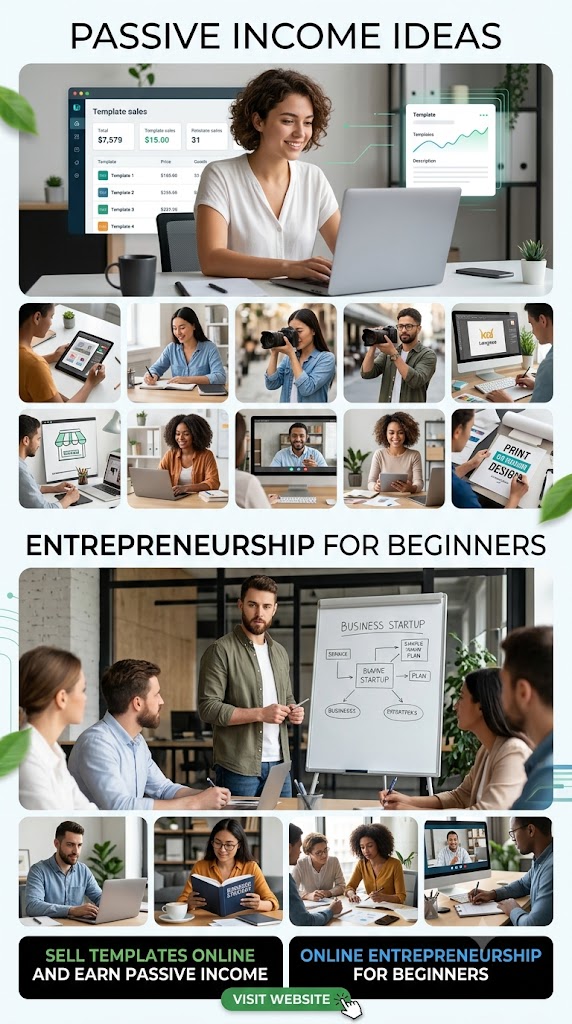
The Complete Blueprint
The allure of passive income is powerful—the idea that you can create something once and get paid for it repeatedly, freeing up your time to travel, spend time with family, or simply not trade hours for dollars. For millions of people, selling digital templates has become the most accessible path to that reality .
And the numbers back this up. The global template market is booming, driven by businesses, creators, and professionals who want professional-grade designs and systems without the cost of hiring a specialist or spending hours learning complex software. For sellers, the economics are compelling: margins are nearly pure profit, startup costs are near zero, and the demand is built-in .
But not all template-selling journeys are created equal. There’s a difference between making a few sales on a marketplace and building a real, scalable business. This guide will walk you through the entire process—from choosing your niche and creating your first template to picking the right platform and scaling your revenue to six figures.
Why Templates Are the Perfect Digital Product for Passive Income
Before diving into the how, let’s look at the why. Why are templates one of the best products to sell online?
1. Low Barrier to Entry
You don’t need to be a developer, a programmer, or even a professional designer to succeed . If you have expertise in a specific area—project management, social media marketing, web design, or even budgeting—you can package that expertise into a template. A project manager can sell their ideal Notion workspace. A real estate agent can sell a set of Canva posts for open houses. A freelancer can sell their client onboarding process. The tools you use to create templates—Canva, Notion, Google Docs, and Figma—are often free or affordable and easy to learn .
2. The Economics Are Unbeatable
Once a template is created, the cost of selling it again is practically zero. There is no inventory to store, no shipping fees, and no per-unit production cost. For example, selling a $47 template 100 times yields $4,700 in nearly pure profit, with only platform fees and payment processing costs to deduct . As one expert noted, the best-case scenario for selling website templates can bring in $100,000 in revenue .
3. Demand Is Built-In
People don’t buy templates for the sake of owning a file. They buy them because they want a shortcut . They want to skip the blank page, avoid the learning curve, and get a finished framework they can customize. This intent-driven purchase makes templates one of the highest-converting types of digital products . Businesses, in particular, are constantly looking for ways to improve their efficiency; email templates that generate a 3,600% return on investment are especially valuable to them .
4. Templates Are a Gateway to Bigger Products
This is the part most sellers miss. A $19 template buyer is the perfect customer for your $47 bundle, your monthly subscription vault, and eventually, your $297 online course . Templates aren’t just a product; they are the entry point to a product ladder that can scale your income significantly.
Step 1: Pick Your Template Niche (Specificity Wins)
The biggest mistake new template sellers make is going too broad. “Canva templates” is a market with millions of listings. “Canva Instagram story templates for real estate agents” is a business .
The Niche Formula: Tool + Audience + Use Case
To stand out, you need to be specific. Use this formula to define your niche:
- Tool: What platform will your template be built on? (e.g., Notion, Canva, Figma, Google Sheets, Microsoft Word, or a website builder like Squarespace or Webflow).
- Audience: Who are you creating this for? (e.g., freelance web designers, real estate agents, course creators, SaaS startups, or personal finance enthusiasts).
- Use Case: What specific problem does it solve? (e.g., client onboarding, project management, listing presentations, or social media content planning) .
Popular Template Niches With Pricing Benchmarks
Different templates command different price points. Here’s a breakdown of what’s selling right now :
| Template Type | Examples | Single Price | Bundle Price |
|---|---|---|---|
| Notion Templates | Project management, life OS, habit trackers, CRM | $9–$47 | $27–$97 |
| Canva Templates | Social media posts, presentations, branding kits | $5–$27 | $47–$147 |
| Figma/Design Templates | UI kits, wireframes, design systems, icon packs | $19–$97 | $97–$297 |
| Spreadsheet Templates | Budgets, financial trackers, business planning | $9–$47 | $27–$97 |
| Website Templates | Landing pages, portfolio sites, full website kits | $19–$67 | $47–$197 |
| Document Templates | Contracts, proposals, SOPs, client onboarding | $9–$47 | $27–$97 |
| Email Templates | Newsletters, promotional campaigns, cold outreach | $9–$37 | $27–$97 |
Step 2: Create Templates People Actually Want to Buy
Creating a template is not just about design; it’s about solving a problem. The best templates are born from creators who built something to solve their own pain points and then realized others have the same problem .
Design With Customization in Mind
Your template is a starting point for someone else. It needs to be easy to customize, even for people who aren’t confident using the design tool .
- Organize Your Files: In Canva, label layers and group elements logically. In Figma or Photoshop, use folders and clear naming conventions. This reduces support questions and builds trust .
- Create a Simple Guide: Don’t assume your buyer is a pro. Add a short guide or video showing how to swap images, change colors, or adjust text. This seemingly small step can significantly boost customer satisfaction and reduce refund requests .
- Test, Test, Test: Before launching, have a friend or colleague test the template. Can they open it, follow your instructions, and customize it without asking you for help? If they get stuck, your instructions need work .
Polish Matters
The quality of your template’s design directly impacts its perceived value. A poorly formatted Notion template or a Canva template with misaligned elements signals low quality, even if the underlying structure is solid . Taking the extra time to polish the design is an investment in your success.
Use AI to Accelerate Creation
You can leverage AI tools to speed up the process and improve your offerings . For example, AI-powered website builders like ZipWP can generate a first-draft website template from a simple text prompt in seconds, leaving you to add your unique flair . AI can also help you generate compelling product descriptions and sales copy .
Step 3: Package Your Templates (Bundles Beat Singles)
How you package your templates is a core part of your pricing strategy. A simple hierarchy works across all template types :
- Single Template ($9–$27): The entry point. Low commitment, easy yes. This is your customer acquisition product.
- Template Bundle ($47–$197): Three to ten related templates packaged together at a perceived discount. This is where most of your revenue comes from. A $47 bundle will outsell five individual $9 templates.
- Template + Tutorial ($27–$97): A template plus a video walkthrough showing how to use and customize it. The tutorial adds significant perceived value.
- Premium Tier ($97–$297): Template + customization guide + community access. This is where template selling starts to feel like a real business.
Step 4: Choose Your Platform Wisely
Where you sell your templates is one of the most critical decisions you’ll make. The choice is often between a marketplace and your own website or storefront. Each has distinct trade-offs .
Marketplaces (Etsy, Creative Market, Gumroad)
Marketplaces are excellent for testing the waters and tapping into a built-in audience of buyers .
- Pros: Instant access to millions of active shoppers, low barrier to entry, and the platform handles payment processing and sometimes fulfillment.
- Cons: High competition, limited control over branding, and significant fees can eat into your profits .
Platform Fee Breakdown for a $47 Template :
| Platform | Fees | Your Keep Per Sale ($47) | Monthly Cost |
|---|---|---|---|
| Gumroad | ~10% + processing fees | ~$40.64 | Free |
| Etsy | 6.5% + listing fee + processing fees | ~$42.50 | Free + $0.20 listing fee |
| Creative Market | ~40-50% commission | ~$23.50-$28.20 | Free (application req.) |
Your Own Storefront (SamCart, Shopify, Kajabi, Sellfy, Podia)
Creating your own storefront gives you maximum control, higher profit margins, and the ability to use advanced marketing features .
- Pros: You own the customer list, have full brand control, keep more of your revenue (no transaction fees on many platforms), and can implement upsells and order bumps to significantly increase your average order value .
- Cons: Requires more upfront work to set up and you are responsible for driving your own traffic.
Example: The Difference at Scale
At 100 sales per month on a $47 template, here is what you keep on different platforms :
- Gumroad: ~$4,064
- Etsy: ~$4,250
- Creative Market: ~$3,290
- SamCart: ~$4,455
And this doesn’t even account for the additional revenue from upsells on a platform like SamCart, which is not available on marketplaces. The smart play: start on a marketplace to validate your idea, then move to your own storefront to build a real business.
Note on Webflow: Platforms like Webflow have even more creator-friendly commission structures, allowing creators to earn up to 95% commission on their templates and sell them anywhere with fulfillment links .
Step 5: Master the Art of Marketing
A great product is only half the battle. To generate passive income, you need a system for getting your templates in front of the right people.
The Marketplace SEO Strategy
When selling on a marketplace like Etsy or Creative Market, your primary marketing tool is SEO. You need to think like a buyer. Instead of a generic title like “Business Planner,” use a descriptive, long-tail keyword phrase like “ADHD-Friendly Daily Business Planner for Creative Freelancers” .
Build an Audience (Drive Traffic to Your Own Store)
If you’re selling on your own platform, you need to attract an audience. Here’s where template buyers hang out :
- Social Media Platforms: Twitter/X is a goldmine for Notion and productivity template creators, with active communities using hashtags like #NotionTemplate and #BuildInPublic. Pinterest is a powerful visual search engine for Canva templates . LinkedIn is excellent for business-focused templates like resumes, proposals, and financial trackers.
- Content Marketing: Create blog posts, YouTube tutorials, or Instagram reels related to your template’s use case. For example, a series of “Real Estate Marketing Tips” videos can lead viewers to your Canva template bundle.
- Affiliate and Partner Programs: If you don’t have an audience, partner with someone who does. You can become an affiliate designer for an established template store or collaborate with a designer to promote your templates for a percentage of the profit .
Step 6: Unlock the Power of Upsells (Where the Real Money Is)
This is the step that separates side hustles from six-figure businesses. Once a customer has bought your entry-level template, the hardest part is over—they’ve decided to trust you with their money . Now, make the most of it.
- Order Bump: Offer a small, related add-on at checkout. Example: “Add the customization video guide for $17?” These can convert at 35-40%, significantly boosting your average order value .
- One-Click Upsell: After the initial purchase, offer a bigger, higher-value product. Example: “Get the complete template vault (10 templates) for $97?” At a 20-25% take rate, this adds a substantial amount to your revenue without acquiring a new customer .
- Product Ladder: As mentioned earlier, use your entry-level template to nurture leads toward more expensive products like bundles, memberships, or courses .
Conclusion: Your Template Business Awaits
Selling templates online is one of the most accessible and profitable ways to earn passive income. It leverages your existing expertise, costs almost nothing to start, and offers unlimited scale.
The blueprint is clear:
- Choose a Specific Niche using the “tool + audience + use case” formula.
- Create High-Quality, Problem-Solving Templates designed for easy customization.
- Package Your Templates into bundles to increase your revenue per customer.
- Start on a Marketplace to validate your product, but plan to move to Your Own Store for higher profits and better customer relationships.
- Master Marketing through SEO on platforms and by building your own audience on social media.
- Implement Upsells and Order Bumps to maximize the value of every single sale.
The journey from idea to passive income won’t happen overnight—it requires upfront effort and active work to build and promote your store . But the payoff is a business that can generate income for months or years with minimal effort.
Your path to earning passive income starts with a single file. What template will you create today?