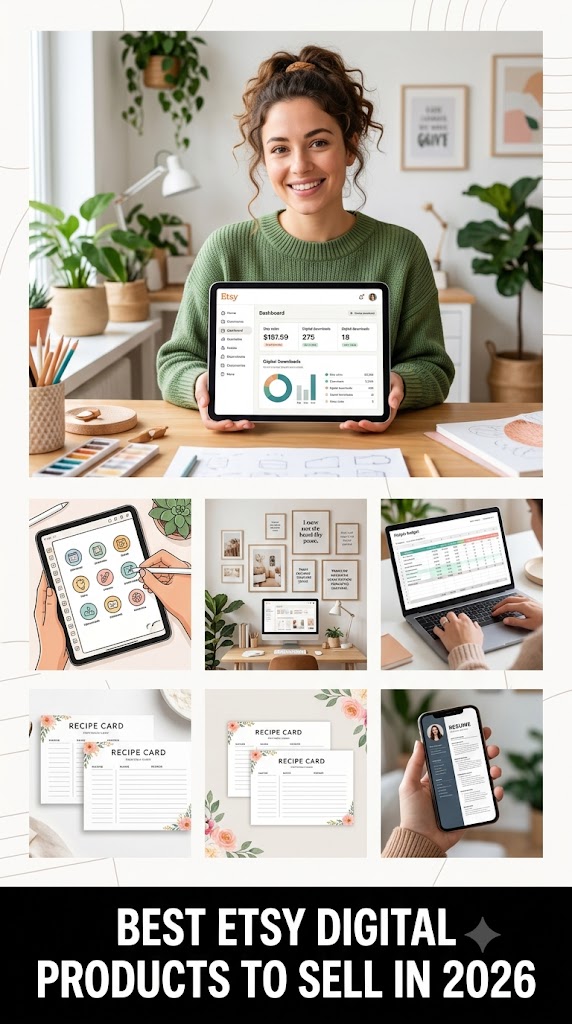
The Complete Guide 2026
Etsy reported 87.3 million active buyers as of , and a growing share of them search specifically for digital downloads. Selling digital products on Etsy offers one of the simplest paths to passive income: you create a product once, list it, and sell it repeatedly with no shipping, no inventory, and no packaging. The profit margins are exceptional because the cost to produce each additional sale is effectively zero. With competition increasing and AI tools making product creation faster than ever, the key to success in 2026 is not just creating a digital product—it’s identifying demand before everyone else does and solving a specific problem for a specific person.
Why Digital Products Work on Etsy
Digital products have become one of Etsy’s most lucrative categories because they offer unmatched scalability. A seller with 50 well-optimized digital listings can realistically earn $500–$3,000 per month with minimal ongoing effort. The business model works because Etsy shoppers arrive with high purchase intent—they’re not browsing; they’re looking for solutions. A well-designed digital product can address a need instantly, making it far easier to convert browsers into buyers than generic physical products.
The shift toward digital has accelerated in 2026 as AI tools have lowered the barrier to entry. This means the competitive advantage now lies not in simply creating products, but in building a data-driven process for identifying opportunities and validating them before investing time. The most successful sellers treat their Etsy shop like a business, paying close attention to search behavior, customer feedback, conversion rates, seasonal demand patterns, and competitor positioning.
The Best Digital Product Categories to Sell
1. Printable Planners and Organizers
Printable planners consistently rank among Etsy’s most popular digital products. The category includes daily planners, weekly planners, meal planners, fitness trackers, budget planners, and habit trackers. The demand is high because people actively seek organizational tools to manage their lives, and printable versions offer instant access at a fraction of the cost of physical planners.
Why it works: These products are easy to create in Canva, have high demand across multiple niches, and buyers understand them instantly. You can create many variations within a single theme, making it a scalable product line.
Specific ideas that sell well:
- ADHD planners with time-blocking and habit streaks
- Mom planners with meal planning and kids’ activity tracking
- Student planners with assignment trackers
- Wedding planners with checklist formats
- Budget trackers with debt payoff sheets and savings challenges
A generic “weekly planner printable” competes with 200,000 listings. A “weekly planner for ADHD adults with time-blocking and habit streaks” competes with far fewer and speaks directly to a buyer’s real need. The more specific the product, the better it converts.
Potential pricing: $5–$15 for individual planners, $20–$40 for comprehensive bundles.
2. Canva and Notion Templates
Templates are one of the strongest categories in Etsy’s digital marketplace. Businesses need social media posts, coaches need PDFs, creators need ebooks, and most people don’t want to design from scratch. This is where you can build a thriving business by creating ready-to-use templates that save buyers time and effort.
Canva templates dominate this space because Canva is user-friendly and widely adopted. Popular options include Instagram post templates, Pinterest pin templates, ebook templates, business card templates, media kits, and presentation templates.
The key to success: Specificity drives sales. A listing titled “Real estate agent business card template for Canva” targets a clear audience, while a generic “Business card template” competes with thousands of similar listings.
Notion templates have become another massive opportunity. Notion users are obsessed with templates for systems they can duplicate instantly. Goal trackers, content planners, finance dashboards, study planners, and client CRMs all sell well. These products save time—and people pay for saved time.
Emerging opportunity: Wedding website templates made entirely in Canva are selling for over $20 and generating significant monthly revenue. One listing under five months old was estimated to earn $4,000 per month with three sales in a single 24-hour period. The Canva platform makes these surprisingly easy to create, and you can attract different types of brides by varying fonts, colors, and overall aesthetics. Sellers should resist pricing these below $20—buyers are willing to pay for quality, and undercutting hurts the entire category.
Potential pricing: $10–$30 for individual templates, $30–$60 for template bundles or comprehensive suites.
3. AI Prompt Packs
The AI-related product market is the fastest-growing category on Etsy in 2026. People want better results from AI tools like ChatGPT, Claude, and Midjourney, but they don’t always know what to type. They buy prompts because they need outcomes, not technical knowledge.
What sells:
- ChatGPT prompts for business and marketing
- AI writing prompts for content creation
- Midjourney image prompts for specific aesthetics
- Productivity prompts and workflow systems
- Prompt bundles tailored to specific niches
The important shift: Generic “10,000 prompt” bundles are becoming commoditized. What sells now are specific, outcome-driven prompt kits. For example, “Etsy SEO prompts for digital planners” or “ATS-friendly resume prompt kits” perform much better than broad collections. Buyers want results, not volume.
Potential pricing: $7–$20 for niche prompt packs, $25–$40 for comprehensive bundles with instructions and examples.
4. Digital Wall Art and Posters
Printable wall art and posters consistently rank among Etsy’s best-selling digital products. The global digital printing market is set to reach $57.03 billion by 2030, and wall art remains one of the strongest digital downloads on Etsy thanks to instant delivery, affordability, and convenience.
What sells best:
- Printable quotes and affirmations
- Typography art (modern, minimalist, retro)
- Botanical and nature illustrations
- Nursery and kids’ room art
- Seasonal décor bundles (Christmas, Halloween, Valentine’s Day)
- Abstract and geometric art
- Gallery-wall sets and matching series
- Zodiac, horoscope, and celestial art
Success strategy: Target a specific style or room. Buyers often search for printable art by aesthetic (minimalist, botanical, abstract), color palette, or room type (nursery, home office, kitchen). Include multiple sizes (4×6, 5×7, 8×10, A4, A3) in a single listing so buyers can print artwork to fit different frames.
One design can become multiple listings. Offer variations in color, size, and format to turn one design into a library of listings with minimal extra work.
Potential pricing: $4–$15 per print, $20–$50 for gallery-wall bundles.
5. SVG Cut Files and Clipart
Cricut and Silhouette machine users are among the most active buying communities on Etsy, with SVG cut files leading the category. These files are commonly used for vinyl decals, heat-transfer designs, and paper crafts. PNG clipart bundles are also popular among digital scrapbookers and designers.
Why this works: The Cricut and home crafting community continues to grow rapidly, and demand for SVG files shows no signs of slowing. This niche rewards volume—sellers who create large themed bundles (holiday SVG sets, floral clipart collections) can encourage repeat purchases from buyers returning for matching designs.
Specific ideas:
- Holiday and seasonal SVG bundles
- Floral and botanical clipart collections
- Monogram and letter sets
- Wedding and event SVG designs
- Children’s and educational clipart
Potential pricing: $3–$10 for individual files, $15–$40 for large themed bundles.
6. Wedding Invitation Templates
Editable wedding invitation templates continue to dominate the wedding space, giving couples creative control without the designer price tag. Modern shoppers want something they can tweak to match their colors, fonts, and theme before sending to print.
Why it’s lucrative: This niche offers steady year-round sales and some of the highest average order values in Etsy’s digital product category. Shops offering cohesive suites—invites, RSVPs, menus, and signage—consistently outperform those selling one-off designs.
Key subcategories:
- Canva or Templett invitation suites
- Complete wedding bundles (invite, RSVP, details)
- Coordinated stationery sets for showers and receptions
- Editable signage and seating charts
- Save-the-date and thank-you templates
Wedding templates are one of the few digital products consistently selling for over $20. Some listings generate thousands in monthly revenue from just a few sales per day. This is a category where premium pricing is both expected and accepted.
Potential pricing: $20–$40 for individual templates, $40–$80 for complete wedding suites.
7. Resume and Cover Letter Templates
Job seekers need professional-looking resumes without hiring expensive designers. This creates consistent demand for templates that look polished and communicate value. The product solves a direct problem—getting hired—which makes it easy to market and sell.
What to create:
- Modern resume templates
- Creative resume designs
- ATS-friendly resumes
- Cover letter bundles
- Portfolio templates
Success tip: ATS-friendly resumes are particularly popular because job seekers know their applications need to pass automated screening systems. Include instructions on how to customize and use the templates effectively.
Potential pricing: $10–$25 for individual templates, $25–$45 for comprehensive resume and cover letter bundles.
8. Budget Spreadsheets and Financial Trackers
Money templates sell because people want control over their finances but spreadsheets can feel intimidating. By simplifying the process and creating visually appealing, functional tools, you can tap into steady demand.
What works:
- Monthly budget tracker
- Debt payoff tracker
- Savings planner
- Expense calculator
- Small business bookkeeping spreadsheet
Pricing strategy: A simple monthly budget tracker might list for $3–$7. A detailed small business bookkeeping spreadsheet with formulas, categories, and instructions can justify $15–$30. Google Sheets templates work particularly well since buyers access them across devices without purchasing additional software.
Potential pricing: $5–$10 for simple trackers, $15–$30 for comprehensive financial systems.
9. Digital Journals and Self-Improvement Resources
Journaling is experiencing a surge in popularity driven by mental wellness trends, self-growth movements, and the desire for reflection. People want guided help, and digital journals provide instant access at accessible prices.
Popular subcategories:
- Gratitude journals
- Anxiety and mental health journals
- Self-care planners
- Shadow work prompts
- Daily reflection journals
These products connect emotionally with buyers, which can build brand loyalty and encourage repeat purchases. The personal nature of journaling means customers often return to the same shop for related products.
Potential pricing: $7–$15 for individual journals, $20–$35 for comprehensive journal bundles.
10. Educational Resources and eBooks
Expertise in a skill or subject can be turned into sellable digital assets. Etsy buyers purchase crochet patterns, knitting charts, language worksheets, photography guides, and business templates. The key is to focus on a specific technique or skill rather than creating broad, general guides.
Popular categories:
- Crochet and knitting patterns
- Language learning worksheets
- Photography guides
- Business templates and contracts
- Homeschool materials
- Activity packs for children
PDFs in this category can be built quickly using AI tools. One seller created a “Meal Prep for Busy People” guide using ChatGPT for recipes and shopping lists, designed it in Canva, and had it listed for $7 within two hours. Within three months, she had 10 different PDFs generating around $3,000 per month.
Potential pricing: $5–$15 for simple guides, $15–$40 for comprehensive pattern collections or course materials.
11. Custom Digital Banners (Low Competition Opportunity)
Custom digital banners represent a low-competition opportunity with strong demand. Buyers purchase these designs at $20–$25 and print them at stores like Walgreens for events, parties, and celebrations.
Why this works: These products have lower competition than many other digital categories. Sellers can create themed designs for birthdays, holidays, weddings, and special events. The designs themselves are straightforward to create in Canva—you’re making a digital file that customers print locally.
Success strategy: Create banners for all major holidays and events. One listing doing $600 per month within two months of launch shows the potential. If you have 20 of these listings running at the same time with different themes, the money compounds quickly.
Important consideration: Some listings in this category include personalization where you customize the banner for the customer. If you offer this, price accordingly to account for revision time. Showing multiple designs in your listing images helps customers choose exactly what they want, reducing revision requests.
Potential pricing: $20–$25 per banner.
12. Fonts and Design Assets
Commercial-use fonts, logo templates, icon packs, and branding kits attract designers, small business owners, and content creators. Several Etsy shops have built massive catalogs in this space, with KAFontDesigns being one of the largest.
License clarity is critical: Buyers need to know exactly what they can do with the files—personal use only, small-business commercial use, or extended commercial license. Offer tiered licensing if possible to capture different customer segments.
Potential pricing: $5–$15 per font, $20–$50 for font families, $15–$40 for brand kits.
How to Identify Profitable Product Opportunities
Success in Etsy’s digital product marketplace comes from understanding what buyers are actually searching for before you create anything. Several tools can help with this research:
Alura and Erank: These tools help research what buyers are searching for on Etsy. Use them to identify underserved niches and validate product ideas.
Profit Tree: This tool helps sellers identify undiscovered and profitable opportunities. In 2026, data-driven sellers use these tools to find product categories with high demand and low competition.
Review mining: Use AI to analyze competitor reviews to find and fix common buyer frustrations. This helps you create products that improve on what’s already available.
Competitor analysis: Pay attention to search behavior, customer feedback, conversion rates, seasonal demand patterns, and competitor positioning. Make decisions based on signals rather than assumptions.
Product Development Strategy
The most successful Etsy shops in 2026 are operating more like data-driven businesses than creative businesses. Here’s how to approach product development systematically:
Start with specificity: A generic product competes with thousands of others. A niche product solves a specific problem for a specific person and converts much better. Research keywords and identify underserved subcategories before creating anything.
Bundle products: Create curated bundles to capture a higher price point. For example, sell a financial budget tracker by itself and also bundle it with a weekly habit tracker, fitness tracker, and meal planner. Bundles increase average order value and provide more value to customers.
Iterate based on data: Once you have products live, pay attention to what sells and what doesn’t. Create variations of successful products. Duplicate top-selling listings with different colors, fonts, or target audiences to build out a catalog quickly.
Create a product ladder: Move buyers from a small win to a bigger system. A $5 planner can lead to a $30 bundle, which can lead to a $50 annual subscription.
Use AI tools strategically: AI can accelerate product creation, but your edge isn’t just using AI—it’s your taste, structure, and quality control. Prioritize usability and quality over simply producing volume.
Etsy SEO and Listing Optimization
Creating a great product is only half the battle. Your listing needs to be found. Here are key strategies:
Keyword research: Use tools to identify what buyers are actually searching for before you create anything. A listing titled “Real estate agent business card template for Canva” targets a clear audience with specific search terms, while a generic title competes with thousands of similar listings.
Conversion rate matters more than traffic: Listings with fewer visitors can generate more revenue if they communicate value better through thumbnails, images, and product positioning. Invest in high-quality listing images that show your product in use.
Include all necessary formats: Resolution and file formats matter. Include multiple sizes and formats in a single listing so buyers can use your product immediately.
Answer buyer questions in your listing: Use your listing images and description to answer common questions. Show what’s included, how to use the product, and what results to expect.
Pricing strategy: When you find a product selling well for over $20, resist the temptation to undercut. Premium pricing signals quality and maintains the value of the category. Undercutting hurts everyone.
Conclusion
Selling digital products on Etsy remains one of the most accessible and profitable online business models in 2026. The platform’s 87.3 million active buyers are actively seeking printable planners, templates, AI prompts, wall art, SVG files, wedding invitations, resumes, budget spreadsheets, journals, educational resources, custom banners, and design assets.
The key to success lies not in creating generic products but in identifying specific, underserved niches and building a data-driven approach to product development. The advantage in 2026 isn’t who can create the most products—it’s who can build the best process for finding opportunities and validating them before investing time.
With the right product selection, proper research, and effective listing optimization, a shop with 50 well-crafted digital listings can realistically earn $500–$3,000 per month with minimal ongoing effort. The barrier to entry is low, but the path to success requires strategy, specificity, and a commitment to understanding your market. Start with one product, validate the demand, and build your catalog systematically. The potential for sustainable passive income is real—it just requires the right approach.