
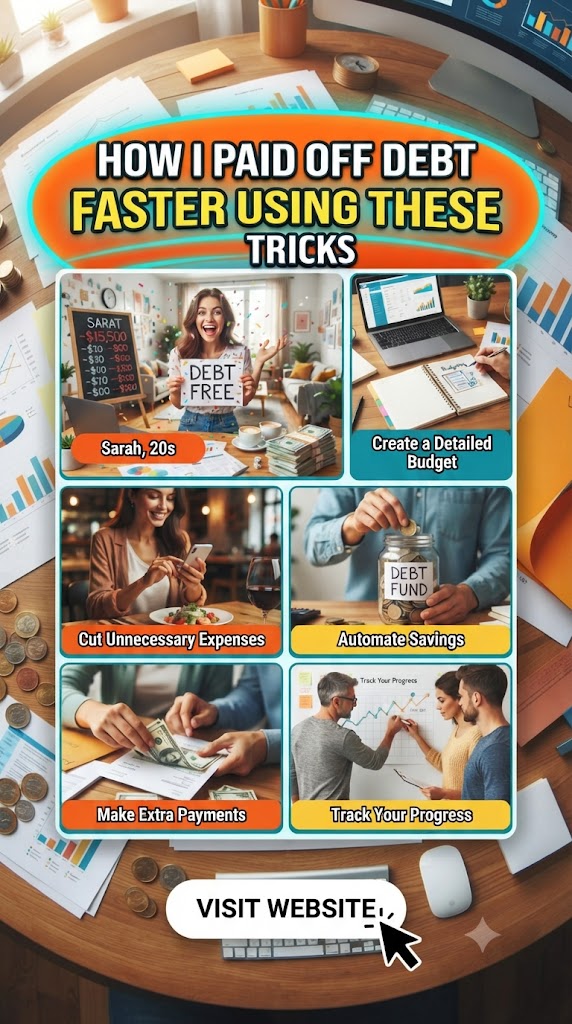
Crushing Debt Faster: How to Reclaim Your Financial Freedom Without Losing Your Mind
Debt is often described as a heavy weight, a dark cloud, or a silent thief. It’s more than just a balance on a screen; it’s an emotional burden that affects your sleep, your relationships, and your ability to dream about the future. For many, the prospect of paying off thousands of dollars in credit cards, student loans, or medical bills feels like trying to empty the ocean with a teaspoon.
But what if the journey to financial freedom didn’t have to be a grueling march of deprivation? What if you could accelerate your debt repayment while actually reducing your stress levels?
This isn’t about magic tricks or “get rich quick” schemes. It’s about a strategic, psychological, and practical overhaul of how you view and handle your money. This comprehensive guide will walk you through the exact steps to eliminate debt faster than you ever thought possible, all while keeping your sanity intact.
Part 1: The Psychological Reset – Why Your Mindset is Your Greatest Asset
Before you touch a calculator or open a spreadsheet, you have to address the space between your ears. Debt is 20% head knowledge and 80% behavior. If you don’t change the way you think about money, you’ll find yourself back in the same hole a year from now.
Stop the Bleeding and Forgive Yourself
The first step is to stop adding to the pile. This means a temporary “plastic surgery”—stop using credit cards immediately. More importantly, you must forgive yourself for past financial mistakes. Guilt is a paralyzing emotion; it doesn’t pay bills. Acknowledge that the debt exists, realize it doesn’t define your worth, and decide that today is the day the cycle ends.
Define Your “Why”
Why do you want to be debt-free? “Because I should” isn’t a strong enough motivator when you’re tempted to buy a $1,200 smartphone on a payment plan. Your “Why” needs to be visceral.
- Is it the ability to quit a job you hate?
- Is it being able to take your kids to Disney World without a credit card?
- Is it simply the peace of waking up and knowing you don’t owe a soul a dime? Write this down. Keep it in your wallet.
Part 2: The “Naked” Financial Audit
You cannot defeat an enemy you haven’t scouted. Most people avoid looking at their total debt because the number is scary. We’re going to do the opposite. We’re going to look it right in the eye.
Step 1: List Everything
Create a simple table (digital or paper) with four columns:
- Creditor Name (Visa, Sallie Mae, Auto Loan, etc.)
- Total Balance
- Interest Rate (APR)
- Minimum Monthly Payment
Step 2: Categorize the Debt
Not all debt is created equal. Categorize them into “Toxic” (high-interest credit cards, payday loans), “Neutral” (moderate-interest personal loans), and “Low-Impact” (mortgages or low-interest student loans). Your focus will primarily be on the Toxic and Neutral categories.
Step 3: Find Your “Nut”
Your “nut” is the absolute minimum amount of money you need to survive every month—rent, basic groceries, utilities, and minimum debt payments. Knowing this number gives you a baseline for how much “extra” you can throw at your debt.
Part 3: The Battle Plans – Snowball vs. Avalanche
There are two primary mathematical frameworks for paying off debt. Neither is “wrong,” but one might be better for you based on your personality.
The Debt Snowball: For the Psychology-Driven
Popularized by Dave Ramsey, the Snowball method ignores interest rates and focuses on balances.
- How it works: Pay the minimum on everything. Throw every extra dollar at the smallest balance first.
- The Benefit: You get a “win” quickly. When that first $400 medical bill disappears, your brain releases dopamine. You feel like you’re winning, which motivates you to tackle the next one.
- Best for: People who need quick wins to stay motivated.
The Debt Avalanche: For the Math-Driven
The Avalanche method focuses on the cost of the debt.
- How it works: Pay the minimum on everything. Throw every extra dollar at the debt with the highest interest rate.
- The Benefit: You pay the least amount of interest over time and finish slightly faster mathematically.
- Best for: People who are disciplined and frustrated by the idea of “wasting” money on high interest.
The “Tsunami” Method: The Emotional Hybrid
Sometimes, a specific debt causes more stress than others—perhaps a loan from a family member or a debt tied to a bad memory. In the Tsunami method, you pay off the most “emotionally expensive” debt first to clear your mental health, then move to Snowball or Avalanche.
Part 4: How to Accelerate the Process Without Burning Out
If you only pay the minimums, you’ll be in debt for decades. To pay it off fast, you need to create a “gap” between your income and your expenses.
1. The “Call and Conquer” Strategy
Before you spend a cent, try to lower the cost of your debt.
- Call your credit card issuers: Tell them you are considering a balance transfer and ask if they can lower your interest rate. If you’ve been a loyal customer, they will often drop it by 2-5%.
- Consolidation: If you have high-interest credit cards but decent credit, a personal loan with a lower interest rate can “collapse” several payments into one, saving you thousands in interest. Warning: Do not do this if you haven’t stopped spending on cards, or you’ll end up with a loan AND new credit card debt.
2. The 48-Hour Rule
To stop new debt, implement a mandatory 48-hour waiting period for any non-essential purchase over $50. Usually, the “must-have” feeling fades by the second day.
3. Micro-Payments
Don’t wait until the end of the month to pay your debt. If you find $20 in an old coat or get a $50 birthday gift, log into your portal and pay it immediately. These “micro-payments” keep your momentum high and prevent the money from being “accidentally” spent on takeout.
Part 5: Finding “Hidden” Money in Your Current Life
You likely have more money available than you realize. It’s just being leaked through “lifestyle creep.”
The “Subscription Scrubber”
Go through your bank statements for the last 90 days. Cancel every subscription you haven’t used in the last month. The $15 Netflix, the $10 gym membership, the $5 app—it adds up. If you find $50 a month in ghost subscriptions, that’s $600 a year toward your debt.
Negotiate Your Monthly Bills
Most people accept their internet, insurance, and cell phone bills as set in stone. They aren’t.
- Insurance: Shop your car and home insurance every 12 months. Switching can often save $300–$500 per year.
- Internet: Call your provider and ask for the “retention department.” Ask for current promotions.
The “No-Spend” Challenge
Pick one weekend a month where you spend $0 on non-essentials. Eat what’s in the pantry, go for a walk in the park, and read a book you already own. It’s a great way to reset your relationship with consumerism and find an extra $100 for your debt.
Part 6: Boosting Your Income – The Power of the Side Hustle
There are two ways to increase the gap: spend less or earn more. Earning more has no ceiling.
The “Sell-Off” Weekend
Walk through your house with a box. Anything you haven’t used in a year goes in the box. Use Facebook Marketplace, eBay, or Poshmark. The goal isn’t to get retail value; the goal is to turn “clutter” into “debt payments.”
High-Margin Side Hustles
Avoid low-paying gig work if possible. Instead, look for skills you already have:
- Freelance Writing/Graphic Design: High demand for quality work.
- Tutoring: If you’re good at math or a second language, you can earn $30-$60/hour.
- Pet Sitting/Dog Walking: Low stress and high demand in urban areas.
- Labor: Pressure washing driveways or cleaning gutters can net hundreds in a single weekend.
Crucial Rule: Every single penny from your side hustle must go directly to debt. If you use it to “upgrade” your lifestyle, you are just working harder to stay in the same place.
Part 7: Managing the Stress – Staying Sane on the Journey
Debt fatigue is real. After 3 or 4 months of “intensity,” many people give up. Here is how to ensure you don’t.
1. Celebrate “Milestones,” Not “Purchases”
When you hit a goal—like paying off 25% of your total debt—celebrate! But don’t celebrate by spending money. Have a “fancy” dinner at home with a nice bottle of wine, or take a day off to go hiking. Associate progress with joy, not with spending.
2. The Visual Tracker
Human beings are visual creatures. Create a “Debt Thermometer” on your fridge or a “Debt Chain” where each link represents $100. Tearing a link off or coloring in a section provides a physical sense of progress that a digital balance cannot match.
3. Practice “Loud Budgeting”
One of the biggest stresses of debt is social pressure. Friends ask you to go to an expensive brunch or a weekend trip. Instead of making excuses, be “loud” about your goals.
- “I’d love to see you guys, but I’m on a mission to pay off my car by December, so I’m skipping the big brunch. Want to grab coffee and go for a walk instead?” True friends will support you; some might even be inspired to join you.
4. Maintain an “Inconvenience Fund”
Stress often comes from unexpected expenses (a flat tire, a broken tooth). If you put every cent toward debt and have $0 in savings, the first “emergency” will force you back into debt, which is incredibly demoralizing. Keep a small “Inconvenience Fund” of $1,000 to $2,000. This isn’t your full emergency fund—that comes later. This is just a buffer to keep you from using credit cards when life happens.
Part 8: Advanced Strategies for Large Debts
If you are dealing with six-figure debt or amounts that seem mathematically impossible given your income, you may need more aggressive tactics.
1. Employer Assistance
Many companies now offer student loan repayment assistance as a benefit. Check with your HR department. It’s essentially free money that directly attacks your principal.
2. Public Service Loan Forgiveness (PSLF)
If you have federal student loans and work for a non-profit or government agency, ensure you are on the right track for forgiveness. This requires 120 qualifying payments, but the remaining balance is forgiven tax-free.
3. Debt Settlement (The Last Resort)
If your debt is already in collections or you are on the verge of bankruptcy, you can sometimes negotiate a “lump sum” settlement for 30–50% of what you owe. Caution: This will damage your credit score significantly and may have tax implications. Always consult a financial professional before pursuing this path.
Part 9: Life After Debt – Building Wealth
The most dangerous time for a formerly indebted person is the month after the final payment is made. Suddenly, you have a massive surplus of cash flow.
Avoid the “I Deserve It” Trap
It’s tempting to go out and buy a new car the moment the debt is gone. Resist this. Instead, take that same amount you were paying toward debt and redirect it:
- Build a Full Emergency Fund: 3 to 6 months of total living expenses. This is your “Peace of Mind” fund.
- Invest for the Future: Start maxing out your 401k or IRA. Now that you aren’t paying interest to banks, you can start earning interest from the market.
- The “Guilt-Free” Luxury Fund: Once your foundations are set, you can finally save up for that big trip or luxury item—paying for it in cash, upfront, with zero stress.
Summary: Your 7-Day Action Plan
If you’re feeling overwhelmed, just do these seven things over the next week:
- Day 1: Stop using all credit cards. Put them in a drawer or a bowl of water in the freezer.
- Day 2: Log into every account and write down your balances and interest rates.
- Day 3: Calculate your “Nut” (survival expenses) and see exactly how much “gap” you have.
- Day 4: Choose your method: Snowball or Avalanche.
- Day 5: Call one service provider (Internet/Insurance) to lower a bill.
- Day 6: List three items on Facebook Marketplace to sell.
- Day 7: Make your first “extra” payment, even if it’s only $10.
Final Thoughts
Paying off debt is not a sprint; it’s a marathon where the terrain gets easier the longer you run. The first few months are the hardest because you’re fighting old habits and inertia. But as those balances drop, the “math” starts working in your favor. Your interest payments get smaller, your principal drops faster, and your confidence grows.
You deserve a life where your paycheck belongs to you, not to a bank. You deserve a life without the 3:00 AM “debt sweats.” Start today. Not Monday, not next month—today. Your future self is already thanking you.
Frequently Asked Questions
Q: Should I save for retirement while paying off debt? A: If your employer offers a 401k match, contribute enough to get the full match—that’s a 100% return on your money. Beyond that, focus heavily on high-interest debt (above 7-8%) before adding more to retirement.
Q: Is it okay to use my savings to pay off debt? A: Keep a $1,000-$2,000 starter emergency fund. Anything above that can be used to wipe out high-interest debt. However, don’t drain your entire life savings; having no cushion often leads back to using credit cards.
Q: How do I stay motivated when I have years of debt left? A: Break it down into “Mini-Goals.” Don’t look at the $50,000 total. Look at the next $5,000. When you hit that, reset. Focus on the mountain immediately in front of you, not the entire range.